
French takes
looks like we have the same prime minister who just resigned ... & other news

I’m back in Colorado for a bit, which means that I have friends here asking me what is happening with France and Macron’s government. Honestly I am not sure anyone knows what’s actually going on, but after another week of political chaos, rounded out with Macron naming the same person as prime minister who had just resigned, I figured it was time for a little French news weekly recap.
When I first saw the headlines that Emmanuel Macron had reappointed Sébastien Lecornu as France’s prime minister only four days after Lecornu resigned, I genuinely thought it was a joke. Lecornu first resigned on Monday, just 24 hours after forming his cabinet, facing opposition both internally and from opposition lawmakers.
Although, technically, nothing prevents Macron from renominating the same person, it also doesn’t make sense. Lécornu was hugely unpopular as a choice for prime minister the first time around, and Macron’s decision to double down on his prime minister choice appears to mainly stem from Lécornu’s loyalty.
Macron’s second term has been marked by government turmoil, and Lécornu was France’s third prime minister in less than a year. No party in government has an absolute majority, leading to political deadlock and an inability, so far, to pass a budget this year.
In France’s snap elections last year, the left-wing New Popular Front coalition won the most seats for the National Assembly. Normally, the French president nominates a prime minister from the majority party. It’s not a law, but it’s a political norm that had been upheld for decades. Many on the left feel betrayed by Macron’s decision to first pick Michel Barnier as prime minister in September 2024. But even after Barnier resigned, Macron dug in his heels and continued to choose right-wing politicians to serve as successive (and short-lived) prime ministers, which has only further angered people on the left—and justifiably so.
It’s not news that people in France feel like Macron is not listening to any of their actual demands, but recommitting to having a hugely unpopular prime minister who resigned just days ago feels even more out of touch than usual—especially at a time when his approval ratings have hit new lows.
Even before Lécornu’s first resignation, opponents on both the left and the far-right were calling for new parliamentary elections (or for Macron to resign). I can’t imagine reappointing Lecornu will satisfy anyone, and Macron has so far been adamant that he will not hold new elections, which could further deter the budget from being passed.
In better news, a man who had appealed his conviction convicted of raping Gisèle Pelicot was condemend again yesterday and sentenced to 10 years in prison—tacking an additional year onto his prior sentence. The man, Husamettin Dogan, was one of the 51 men convicted of raping a drugged Pelicot in a mass trial last year of The jury and judges deliberated for less than three hours. Although she was not required to attend, Pelicot once again sat through the entire trial.
Known as the Mazan trial—after the small Provencal town in southern France where the crimes occurred—the initial case last year threw France into turmoil after Pelicot’s (now ex) husband, Dominique Pelicot, confessed that he put sleeping pills into his wife’s food and drink nearly 10 years, raping her and bringing other men to do the same while she was unconscious.
The trial also created an outpouring of solidarity, bringing together women from all over to support Pelicot during her trial. She chose to make all of the details public, rather than doing a closed-door trial, and this brave decision galvanized an entire movement. As my friend Diane de Vignemont wrote in an excellent story for New Lines Magazine last year, “This trial is not just a pursuit of justice; it is a crucible of solidarity and sisterhood, uniting women from all walks of life in shared outrage and resolve.”
I highly recommend reading Diane’s entire piece; it’s one of the most thoughtful and articulate reflections to come out of all of this.
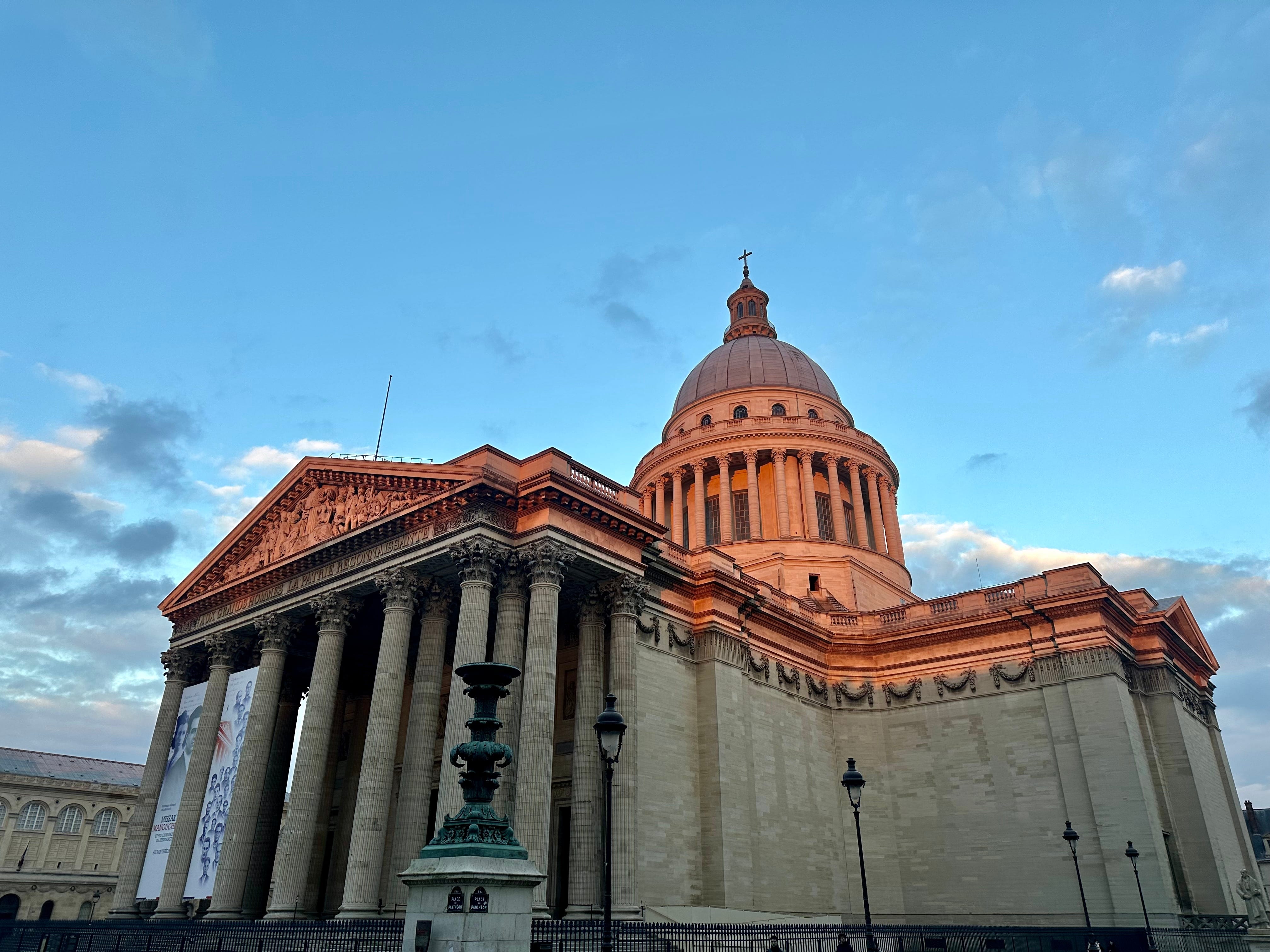
Former justice minister Robert Badinter was inducted into France’s Panthéon, which I learned when my usual running route was barricaded and detoured. He will join the revolutionaries of 1789, Josephine Baker, Marie Curie, Victor Hugo, Voltaire, and many other influential French honored here. Designed by architect Germain Soufflot in 1764, the Panthéon was first created as a church, but during the French Revolution, the National Assembly transformed it into a secular space to honor the memory of the country’s new revolutionaries—essentially a modern take on the Saint-Denis Basilica, which is necropolis of French kings.
Badinter is most well-known for leading France to abolish the death penalty and decriminalizing homosexuality, and he was a strong opponent of the far-right Le Pen family. It feels a bit ironic for Macron to induct Badinter when Macron’s policies and way of governing have in some ways, at minimum catered to the elites and corporations, and at worst, enabled the rise of the far-right in France. Macron does love the idea of a legacy, and honoring Badinter definitely continues this idealized version of his presidency. But I do agree that advocating for a legacy of human rights, justice, and equality is more important than ever.
The first residents moved into what was previously the Paris 2024 Olympic Village, north of Paris in Seine-Saint-Denis. The project faced many challenges, including building on polluted and potentially toxic land. Now around 6,000 people will move into new housing units, including 450 spaces in student residences, in one of the largest developments since France’s villes nouvelles in the 1960s. Of the 2,807 apartments available, 917 are social housing—or about 33%. Although I would like to see more focus even on social housing, especially considering how disruptive (and sometimes harmful) the Olympics were to this area and the people who live here, this project to reconvert the athlete village is promising. France’s Olympics legacy is far from pristine, and foreign construction workers responsible for building one of key arenas for the Olympics still remain undocumented, despite a signed agreement in 2024 that they would receive legal status.
And that’s all for now.