
Heat Waves
(cue the Glass Animals song)

de retour after a very extended hiatus now that life is a little less chaotic.
If you’ve talked to anyone in France recently, they have likely complained about the temperatures. It is WARM, and it looks like next week is trending even higher in parts of the country. Even where I am in the French Alps, temperatures hit 30C (86F) today, which is unusually hot, especially for this time of year.
Climate change hits alpine environments especially hard. Higher temperatures decrease the surface area covered by ice and snow, which reflect the sun’s rays. Snow and ice are then replaced by dark rock and vegetation, which absorb heat from the sun and raise ground temperatures, causing even more melting.
This week, the Compagnie des Guides in Vanoise reported that snow levels below 3,400 meters (11,155 feet) are equivalent to those of July 24, 2024. Above that elevation, the snow is similar to July 17. A local guide in Chamonix told my friend that he expects the summer season for summiting Mont Blanc could be over by next week. Temperatures are already so high that the risks of major rockfall events are growing to dangerous levels. For context, June to September was traditionally the peak season to climb Europe’s tallest mountain. It’s not even July, and conditions have already rapidly deteriorated.
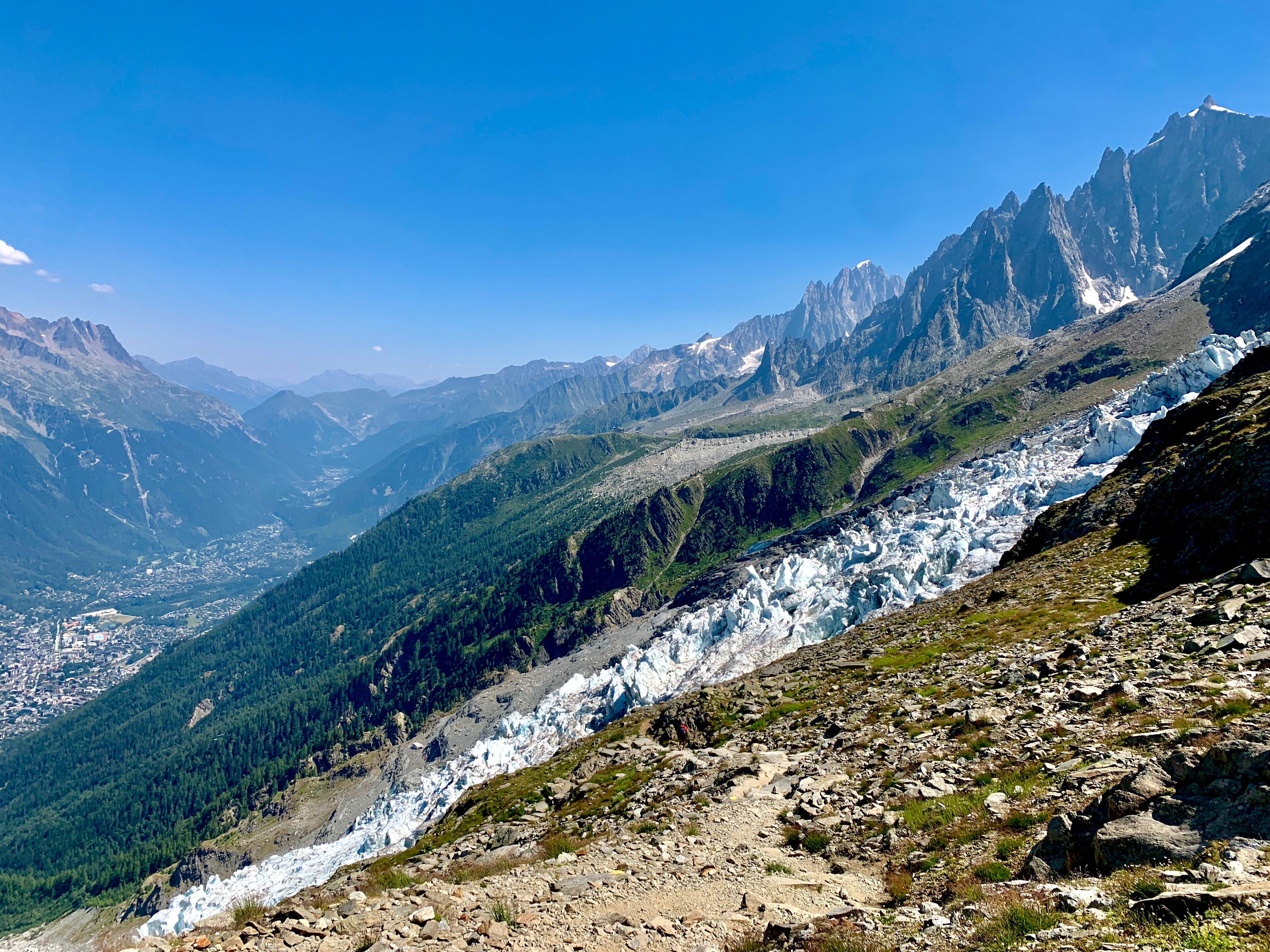
In the valley, I have climbing friends who—after one too many close encounters with microwave-sized rocks nearly falling on their heads—no longer do any high alpine climbing in the summer. Earlier this year, I wrote a story for the High Route about how melting permafrost and retreating glaciers raise the risks associated with high alpine mountaineering in the Alps. You’ll have to buy the print magazine to read the full feature, but as summers grow warmer and drier, large rockfall events are more frequent, and retreating glaciers create unpredictable crevasses and unstable crossings. Mont Blanc is one of the deadliest summits in the world, despite not being very technical. In 2024, five climbers died in one weekend in September, and four died in August. The classic route up Mont Blanc follows the Couloir du Goûter, nicknamed “the death couloir.” With warming temperatures, this zone is increasingly prone to rockfall.
Meanwhile, in France’s capital, people do not have the luxury of cooler nights that mountain air tends to offer. Paris is the most densely populated city in Europe, and very few homes have air conditioning. Even worse, the high temperature point of the day doesn’t tend to hit until 5 or 6 p.m., meaning that it often does not even start to cool down until well after midnight. Most of the classic Haussmanian style apartment buildings are poorly insulated, and the iconic zinc roofs tend to only magnify heat. Buildings are the biggest source of CO2 emissions in Paris (72%). One in two buildings in Paris is over a century old.
Eight of the hottest recorded summers since 1900 in Paris have happened in the last ten years, and the city could see temperatures up to 50C (120F) by 2050. As beautiful as Paris is, the city does not have enough green space, and there are large areas of the city where the concrete traps in the heat, with little natural protection to shield people from the sun’s rays.
So what’s being done? At the municipal level, the city of Paris introduced a new climate plan at the end of 2023, with a target to be carbon neutral by 2050. Measures include a commitment to using 100% renewable energy to power all municipal public facilities by 2040 and phasing out all internal combustion engines in public transit by 2030. The city is prioritizing renovating schools, public buildings, and social housing. This winter, the city planted 150,000 trees.
There have been discussions to uncover parts of the Bièvres river—a Seine tributary that runs through the city, which was covered up after it became a cesspool from tanners soaking animal skins, butchers dumping animal guts, and other Parisians dumping refuse, turning the small river into an open sewer. The city has transformed too much to uncover the entire river, but there are sections less than ten feet below the surface in several zones that could help mitigate temperatures in the city and reintroduce more natural areas, more green spaces.
As with most climate action, some of the proposed adaptations seem much too slow (and classically mired in French bureaucracy), and the plans for this summer feel very short-term: installing more misters, opening a section of the Seine for swimming, adding shaded areas in public spaces. But after escaping from being sardine-ed inside an overcrowded metro car with no ventilation, diving in the Seine might not sound like such a terrible idea, E. coli or not.